Secondary 3 Chemistry students often face difficulties when tackling questions that involve both mole concept and chemical equations. A common stumbling block is understanding how limiting reagents affect the amount of precipitate formed, especially when solutions are mixed in varying volumes.
Take this question as an example:
When solutions of lead(II) nitrate and sodium iodide are mixed, lead(II) iodide is precipitated as shown by the equation:
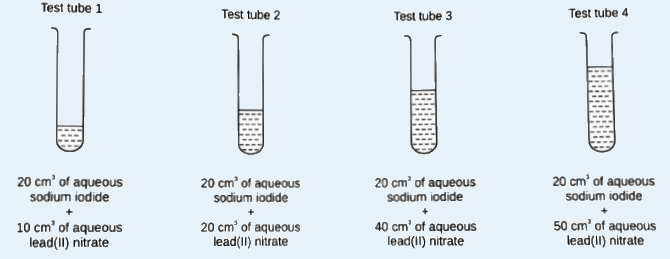
Pb(NO₃)₂ (aq) + 2NaI (aq) → PbI₂ (s) + 2NaNO₃ (aq)Same volumes of 1.00 mol/dm³ aqueous sodium iodide are added to different volumes of 0.500 mol/dm³ aqueous lead(II) nitrate in each of the four test tubes 1 to 4 as shown below.
Which statement is true after the precipitate settles?
A. The amount of precipitate in all four test tubes are the same.
B. The amount of precipitate increases consecutively from test tubes 1 to 4.
C. The amount of precipitate increases from test tube 1 to 2 but are the same in test tubes 3 and 4.
D. The amount of precipitate increases from test tubes 1 to 3, but are the same in test tubes 3 and 4.
Questions like this test conceptual understanding. Students who grasp the mole concept deeply can apply it across different scenarios, regardless of how the question is framed. Here’s how one student used instant, on-demand homework help to get guidance from a mentor and work through this step by step: