Primary Science often tests understanding of the three states of matter through real-life application questions. One common example involves a compressed towel, a concept many students encounter in Japanese, Korean and Chinese restaurants in Singapore. This question challenges learners to apply scientific knowledge beyond textbooks and into everyday situations, just like PSLE-style examination questions.
Science Question on Compressed Towel:
The diagram below shows the compressed towel after adding water. Based on Isabelle’s observation, what is the state of matter of the compressed towel? Give a reason for your answer.
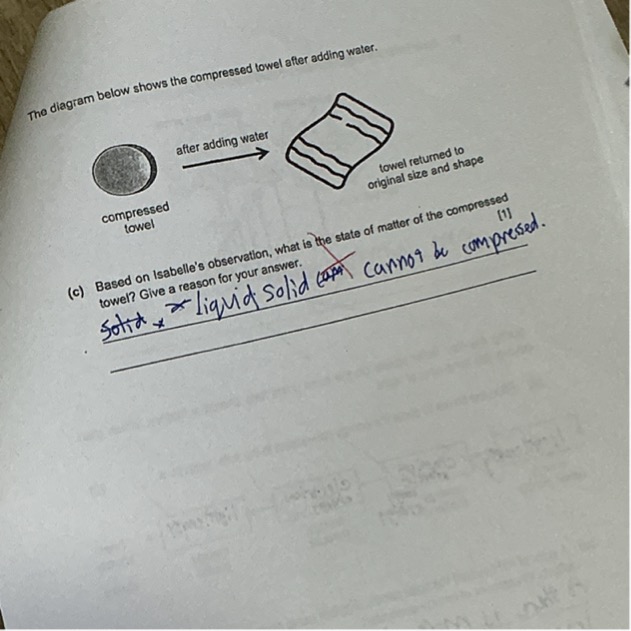
This question often confuses students because a towel appears solid in everyday use. However, the compressed form raises an important scientific idea: can solids be compressed? Many learners recall that gases can be compressed, while solids and liquids cannot be compressed. This creates a moment of uncertainty when students try to classify the compressed towel using the states of matter concept.
Real-life application questions like this test more than memorisation. They assess whether a student can observe, interpret and apply Science concepts to unfamiliar situations. The compressed towel expands back to its original size when water is added, making it a strong example used in Primary Science learning and PSLE preparation.
Students who develop strong reasoning skills in such questions build confidence as a self-motivated learner and grow into a confident learner who can handle higher-order thinking tasks. Platforms like Superstar Teacher provide online lessons and on-demand homework help, supporting students when they struggle with challenging questions like this.
Scroll down to explore the mentor-student chat and discover the full explanation behind this interesting real-life Science phenomenon.