fbpx
Homework Help
EnglishPrimary

Does vs Doesn’t: Easy Grammar Rules to Master Question Tags

Does vs doesn’t. This small difference can easily confuse Primary English students, especially when answering questions that use question tags.


Consider this Primary English question on Does vs doesn’t:

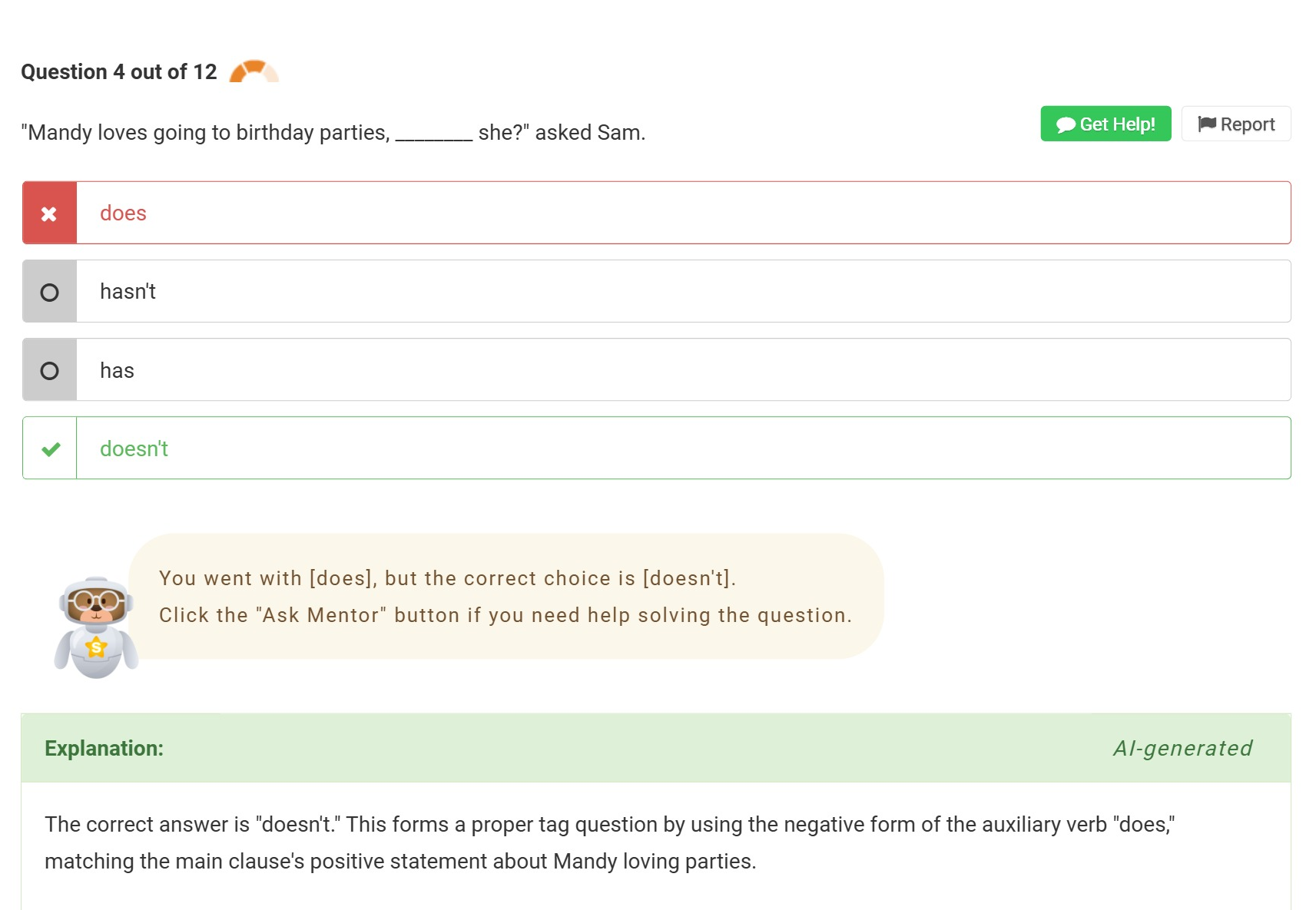
“Mandy loves going to birthday parties, ____ she?” asked Sam.

(1) does
(2) hasn’t
(3) has
(4) doesn’t


At first glance, both “does” and “doesn’t” may seem possible. So, how can students decide which answer fits?

The key is to understand the grammar rules behind question tags instead of trying to memorise each answer. A question tag is a short question added to the end of a statement. In general, a positive statement takes a negative question tag, while a negative statement takes a positive question tag.

Here, “Mandy loves going to birthday parties” is a positive statement. The question tag therefore needs to be negative: “doesn’t she?” This makes the correct answer (4) doesn’t.
Confused by does vs doesn’t? Learn the grammar rules behind question tags with a simple Primary English example and build confidence through better reading.

Students who understand this pattern can handle many similar English questions with greater confidence. Regular reading also helps because students naturally encounter common sentence structures repeatedly in books and stories.

For students who need help understanding grammar questions, Superstar Teacher’s Instant Homework Help provides on-demand support from mentors, helping students understand the reasoning behind an answer instead of simply memorising it.

Maple

  • Hi
  • Hi!
  • Oh. Hi again! I met you last time
  • Yes you did, hi again :)
  • Why am I wrong?..........
  • ???????
  • :(
  • :|
  • <u>uuhhhhhhhhhhhhh</u>
  • Okay so this is a common sentence type. Usually they say something, and then ask the opposite of that. For example, Mandy loves going to birthday parties doesn't she? 
  • So her loving going to birthday parties is something that she does, so they ask the opposite which is doesn't she?
  • But what about does? When do we use it???.....
  • Conversely, take this for example:
    <div>
    </div><div>Mandy doesn't really go to birthday parties, does she?</div>
  • Does is the most common and you'll be encountering that most of the time in Primary English
  • Oh...... So they are like opposite use.........Right??Hah?
  • yes!
  • Doesn't is does. Does is doesn't.right?
  • yes
  • Oh!
  • Now I get it! Thanks!
  • but don't memorise it...
  • understand it
  • It comes with reading! I would recommend Enid Blyton. That series really exposes you to many different sentence types :)
  • Goodbyee! I will! :)
  • bye!
  • see ya

Find the right plan for your child

Compare the free trial and Core Subject subscription to see what’s included

View plans & pricing