
Before You React to Your Child’s Exam Results, Read This
Exam results are often seen as the defining moment of a child’s progress, which is why they tend to bring a mix of emotions for both parents and children when they are released. But beyond the scores, what truly shapes a child’s experience is the way those results are discussed at home.
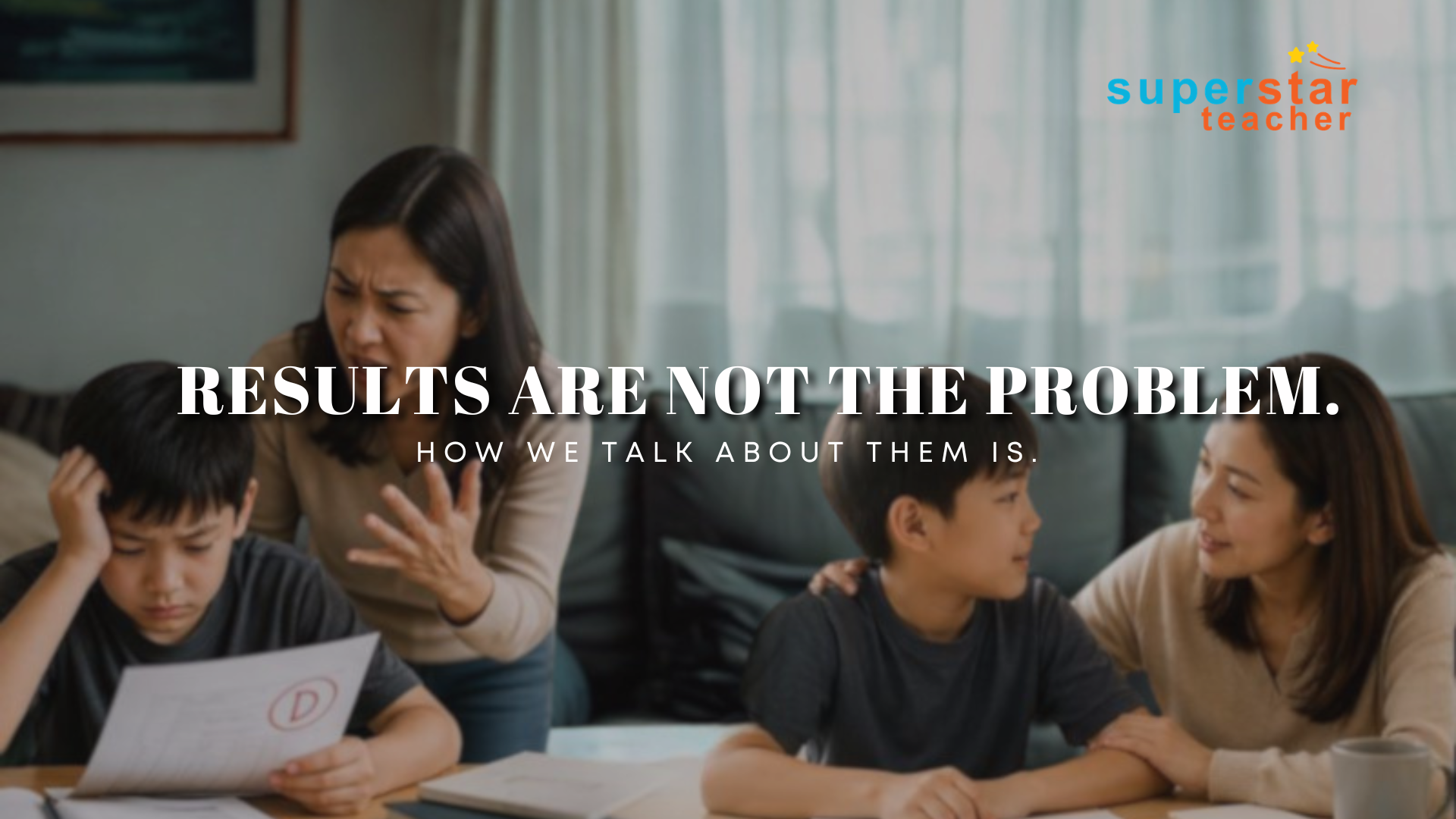
When your child brings home their results, what is your first reaction? For many parents, it is a moment filled with mixed emotions. Concern, disappointment and worry can quickly take over, especially when expectations are not met.
In that moment, it is common for frustration to surface through questions like:
- “Why so careless?”
- “Didn’t you already study for this?”
- “Why can’t you do better this time?”
These questions usually come from care. Parents want their children to improve and avoid repeating the same mistakes. However, to a child, these words can feel very different.
What Children Actually Hear
Instead of hearing concern, they may hear: “I’m not good enough”, “I’ve let my parents down”, or “No matter how hard I try, it is never enough.” Over time, these interpretations can build up and lead to self-doubt, fear of failure and reluctance to try again.
Why Results Feel Heavier Than They Should
For parents, results feel like a clear measure of progress. But for children, results are emotionally loaded. They represent effort, expectations, stress and sometimes fear.
This is why results conversations often feel tense. Parents are focused on improvement, while children are focused on judgment. Without realising it, both sides are having very different conversations.
Over time, this gap can shape how children view learning. Instead of seeing mistakes as part of the process, they may begin to link results with self-worth. This can lead to fear of failure, hesitation to try and reduced confidence.
Shifting the Conversation
Instead of reacting immediately, the first shift is in how the conversation starts. Moving away from judgement-based questions to curiosity-based ones can change the entire tone.
For example, instead of focusing on what went wrong right away, parents can ask questions like, “Which part of the paper felt the most challenging?”, “Was there anything that surprised you?”, or “Where do you think things started to go off track?”
These questions do not remove accountability. Instead, they invite reflection. They allow children to think through their own learning experience instead of feeling like they need to defend themselves.
Helping Children Reflect
Once the conversation becomes calmer, the next step is helping children make sense of their results in a meaningful way. Instead of immediately jumping to solutions or corrections, it helps to first guide them to make sense of their results.
This can be as simple as asking them what felt difficult, what they were more confident about and where they think things went wrong. These reflections help children move beyond seeing results as just a score and instead begin to recognise patterns in how they learn.
At this stage, the parent’s role is not to provide all the answers, but to help children slow down and think about their own learning process. This builds awareness, which is an important step towards meaningful improvement.
When children are able to articulate their own learning experience, improvement becomes more intentional rather than reactive.
Building Reflection Into Action
Reflection is most effective when it becomes a habit, not a one-time conversation.
Beyond discussions at home, children benefit when they are given a simple way to record and revisit their learning journey over time. This helps them track not only what they scored, but also how they felt about their learning, what they struggled with, and what they want to improve next.
At Superstar Teacher, we support this through a feature where students can submit their test results or learning milestones and write short reflections about their performance. This gives them a structured space to process their learning in their own words, helping them slow down and think beyond the score. Over time, it encourages children to view mistakes as part of learning rather than something to fear.
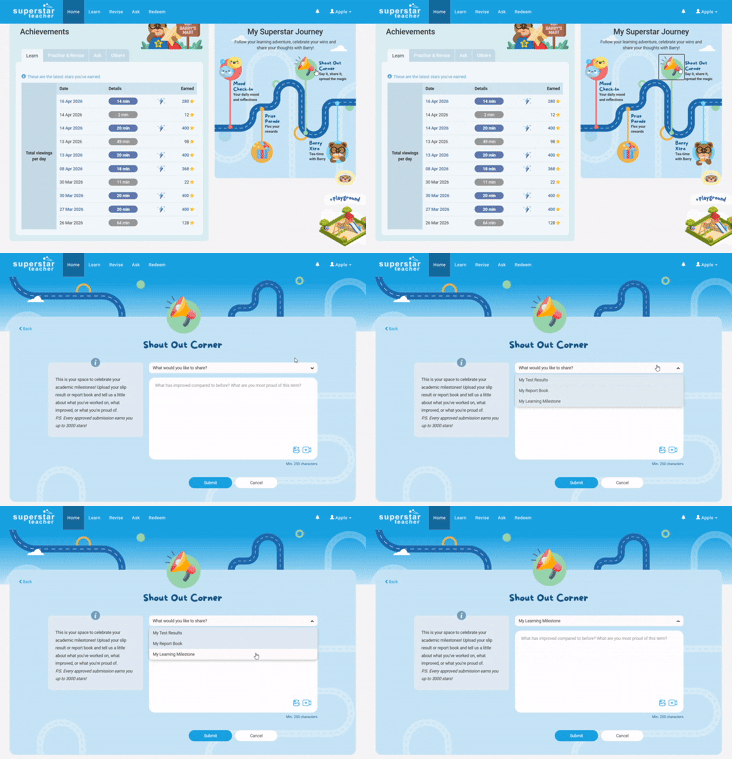
With clearer reflection, children are better able to identify what needs attention, revisit concepts at their own pace and focus on specific areas for improvement in a more guided and confident way.
Timing Matters More Than Words
Even with the right questions and the right approach, one important factor can still shape how the conversation goes: timing.
Not every results conversation needs to happen immediately. If emotions are still high, it is often more helpful to pause and revisit the discussion later.
A calm environment allows for better listening, more thoughtful responses and less resistance from the child. Sometimes, giving space is more effective than trying to resolve everything at once.
What Children Will Remember
In the long run, children may not remember every score they received. But they will remember how those moments felt at home.
They will remember whether they felt supported or judged, understood or criticised, encouraged or pressured.
At the end of the day, talking about results is not really about the marks on the paper. It is about what those moments build at home: confidence, trust and a child’s willingness to keep trying even when things are difficult.
When parents shift from reacting to guiding, results become less of a stressful event and more of a learning opportunity for both parent and child.
About Superstar Teacher
Welcome to Superstar Teacher, where learning meets excitement! As Singapore’s leading online learning platform, we are dedicated to set your child ahead in their academic journey.
Our curriculum is meticulously crafted to align with the latest MOE syllabus, offering dynamic modules for Primary and Secondary students, fostering advanced learning and building a solid foundation. Additionally, our personalised one-on-one sessions make homework enjoyable and manageable, providing tailored support for your child. Our ultimate goal is to achieve exam success for every child. With our competency-based approach, rest assured that your child is equipped with essential skills, gaining insights into question trends and powerful answering techniques.
Join us today and unlock a lifetime of learning success with Superstar Teacher. Discover everything you can access with our free trial.