Gravitational potential energy (GPE) is one of the most commonly tested concepts in Primary Science and PSLE-style problem solving. Many students confuse supporting conditions with energy changes, especially in questions designed to test conceptual understanding.
Are you one of the students who got tricked by this question on gravitational potential energy?
The diagram shows 4 cubes of equal mass supported in different ways. Cubes A and C are hung from a support while B and D are balanced on their support.
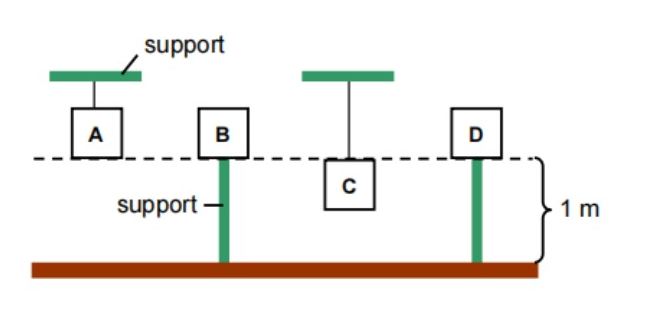
Which of the following statements is true about the amount of gravitational potential energy the cubes possess?
Key Insight
This question contains deliberately distracting information. The way the cubes are supported does not affect gravitational potential energy. Whether a cube is hung or balanced, GPE depends only on two factors: mass and height. Since all cubes have equal mass, the only factor that matters is height. Cubes at the same height have the same GPE, regardless of whether they hang from a support or rest on a surface.
This is a common PSLE Science trap designed to test understanding of potential energy, not memorisation. Many students lose marks by overthinking support conditions instead of focusing on physics principles. Building a confident learner mindset means identifying what actually matters in the question.
Scroll down for the full explanation
The concept becomes much clearer when seen in action. Scroll down to view the real conversation between the mentor and student, where the reasoning is broken down step by step and the common misconception is clarified in a simple way. This is part of Superstar Teacher’s instant homework help and on-demand homework help, designed to help students strengthen understanding of gravitational potential energy and other Primary Science concepts through real examples and guided learning.