
Jeannie

- hi
- Hi<div>
</div> - Let me show you some diagram
- ok

- wow
- ok
- thanks u
- in this range, they are all liquid
- okie
- i understand
- thanks soo much

Session ended by student.

Melting point questions are commonly tested in Primary Science, especially in topics related to the three states of matter. While the concept may seem simple, many students lose marks because they struggle to interpret information from the table and confuse whether a substance is in the solid, liquid or gaseous state at a given temperature.
The table below shows the melting and boiling points of some substances.
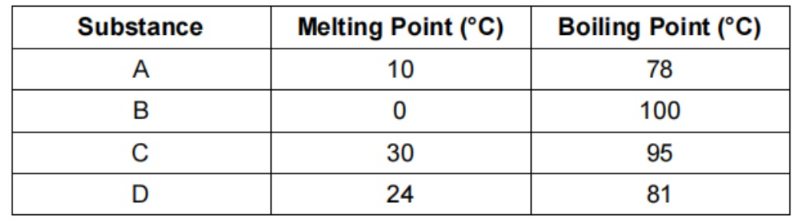
Which of the following statement(s) is/are true? Select all correct answer(s).
At 80°C, substance C changes from liquid state to gaseous state.
At 65°C, only three substances remain in liquid state.
Only two substances are liquid at 15°C.
At 95°C, substance D is in its gaseous state.
To answer questions like this confidently, students must first understand the relationship between melting point, boiling point and the states of matter. When a substance is below its melting point, it remains in the solid state. When the temperature is between its melting point and boiling point, it exists as a liquid. When the temperature rises above its boiling point, it turns into gaseous state.
However, knowing the concept alone is not enough. Exam questions often include tricky statements that require careful comparison. For example, a question may ask whether “only three substances remain in liquid state at 65°C”. Students must check every substance in the table instead of making quick assumptions.
Learning how to analyse these questions step by step helps students avoid careless mistakes and become a more confident learner in Primary Science. When facing challenging Science questions, students can also receive instant homework help and on-demand homework help through Superstar Teacher, where mentors guide them through difficult concepts and solutions.
Review the mentor-student conversation below to see how this melting point question can be solved clearly.
Real mentors, Real-time answers



active learners

on Google & Facebook

time spent daily

Whenever I get stuck on my homework, I use the Instant Homework Help feature to get quick support. The tutors are really kind and patient, and some even explain things in different ways until I understand. It helps me feel more confident about my schoolwork.


Pri 5, Chongfu School
I'm taking my PSLE this year, and the Homework Help feature has really made a difference. Whenever I face a difficult question, I can ask for help and get answers fast. It makes doing homework less stressful and helps me improve in all my subjects.

Pri 6, Ahmad Ibrahim Primary School
Instant Homework Help is one of my favourite features on Superstar Teacher. When I struggle with a tough question, I get help right away, which clears up my doubts and saves time. It's helped me become more confident and motivated in my studies.

Sec 2, St Patrick School

 Adeline Lee, +65 9845 9565
 enquiry@superstarteacher.com


