Have you ever noticed a bright spot appearing under a pencil when it is slowly pulled out of water? This fascinating phenomenon demonstrates the refraction of light and is a common real-life application question in Secondary Physics. Understanding it helps students become self-motivated, confident learners and makes similar questions easier to solve.
Question:
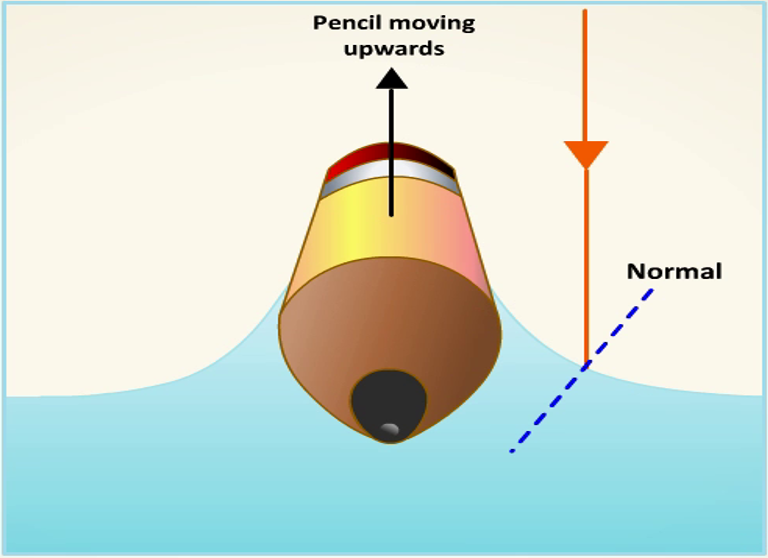
Use the diagram below to explain why a bright spot is formed under the pencil when it is being pulled out of the water. Use ideas about refraction of light to explain the phenomenon.
Why students might find this “bright spot” question tricky
- The diagram shows a pencil and the normal line, but the key principle is how light bends when it moves from water to air.
- Many students struggle to connect this everyday observation to the concept of refraction.
Key principles to understand
-
- Change in medium and speed: Light travels faster in air than water, bending away from the normal as it passes from water (denser) to air (rarer).
- Curved water acts as a lens: Water clinging to the pencil forms a convex shape that focuses light rays.
- Formation of bright spot: The focused light concentrates under the pencil, creating a visible bright spot.
Why this matters
Understanding the bright spot phenomenon shows how Physics concepts apply to real-life situations. It strengthens problem-solving skills and helps students build confidence in Secondary Science.
After reviewing these points, solving the question becomes straightforward. Scroll down to see the chat between the mentor and student to watch the concept applied in practice.